Why Professional Diamond Grinding Matters
The goal is not simply to make a floor look scratched. Effective preparation combines the right tooling, edge work, dust control, inspection, and a profile appropriate for the specified coating.
Professional diamond grinding creates a controlled mechanical profile and removes unsuitable surface material so an epoxy system can bond to sound concrete. Acid etching is less reliable on dense, contaminated, or previously sealed concrete and does not replace coating removal or concrete repair.
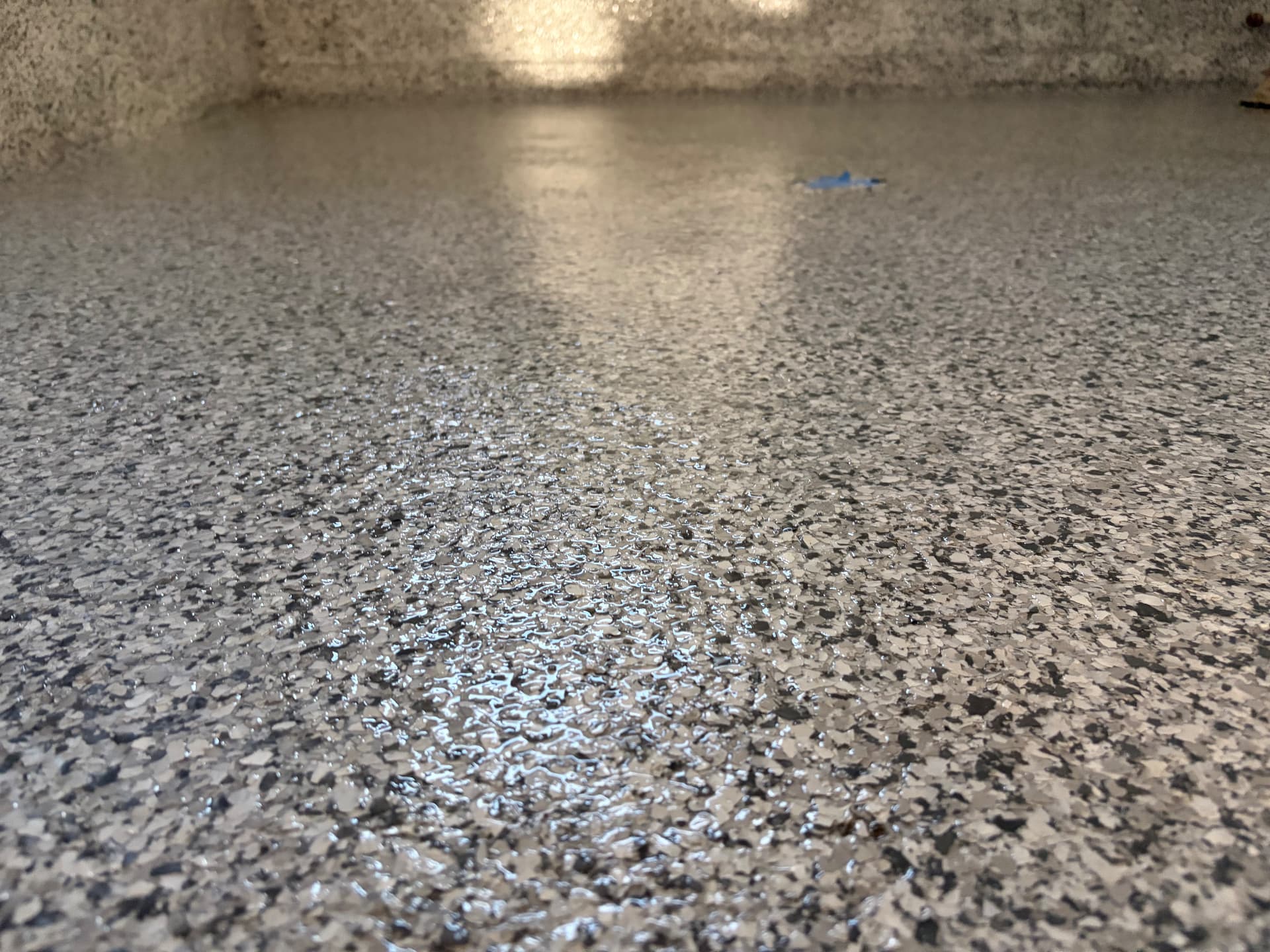
What does diamond grinding do before epoxy?
Diamond tooling cuts or abrades the upper surface of concrete, helping remove weak paste, certain existing finishes, and material that would prevent bonding. It also creates texture that gives a compatible coating a suitable surface to wet and adhere to. Describing this as opening pores is convenient shorthand, but the practical requirement is a sound, clean substrate with the specified mechanical profile. The correct result depends on concrete hardness, tooling, machine setup, and the condition of the original floor. Some surfaces need multiple passes or a different preparation method to reach the profile required by a thicker system. A glossy-looking pass or scattered scratches are not proof that preparation is complete. Inspect the whole area, including places previously covered by paint or storage. Grinding cannot turn weak concrete into strong concrete, and it does not by itself remove every deeply absorbed contaminant. The prepared surface must be evaluated before treating it as an acceptable foundation for the rest of the assembly.
Why is acid etching inconsistent on garage concrete?
Acid reacts with exposed cementitious material, so its effect depends on whether that material is accessible and how uniformly the solution contacts it. Dense or power-troweled surfaces may react unevenly. Sealers, paint, and oil can prevent contact, leaving areas with little useful change even when other parts of the floor appear etched. Acid does not reliably remove old coatings or rebuild loose concrete. The process also introduces water and chemical residues that need controlled handling and removal before coating. An etched appearance is not evidence that contamination, moisture, or weak surface material has been resolved. Acid use has its own exposure and disposal concerns and should not be presented as an easy, harmless shortcut. Some coating products permit specific chemical preparation under defined conditions, but that does not make etching interchangeable with mechanical preparation for every floor. For an epoxy garage system that calls for a mechanical profile, grinding or another specified mechanical method is the relevant approach. Follow the chosen system requirements rather than assuming that any roughness will provide an equivalent bond.
Why do dust collection and edge work matter?
Grinding concrete produces dust that can contain respirable crystalline silica. Suitable extraction at the tool, appropriate filtration, and work practices selected for the exposure are part of the preparation plan, not optional housekeeping. Controlling dust also helps prevent contamination of nearby belongings and the surface that will receive the coating. It does not mean that every operation can be promised as completely dust-free. Fine residue left on the slab can interfere with direct contact between primer and concrete, so thorough vacuuming and inspection remain necessary after grinding. Edges, corners, and thresholds need attention with equipment that can reach them while maintaining appropriate dust control. A floor machine used only in the center can leave an unprepared perimeter that becomes a weak point. Before removing old paint, adhesive, or other finishes, consider whether they may require hazardous-material assessment. Ordinary concrete grinding equipment is not a substitute for appropriate precautions where suspect materials are present. The aim is consistent preparation without transferring the risks to the garage, the household, or the workers.
| Method | Useful role | Important limitation |
|---|---|---|
| Diamond grinding | Creates a mechanical profile and can remove unsuitable surface material with appropriate tooling. | Must match the concrete and required profile; deep oil and unsound concrete may need more work. |
| Acid etching | Chemically reacts with accessible cementitious material where an approved specification permits it. | Can be uneven on dense, sealed, oily, or coated surfaces and introduces water and residue. |
| Washing or degreasing | Removes loose soil and suitable surface contamination before further preparation. | Does not establish a mechanical profile or guarantee removal of absorbed contamination. |
| Handheld edge equipment | Reaches perimeter areas and details inaccessible to a larger grinder. | Needs suitable tooling, dust control, and consistency with the main floor preparation. |
- Identify previous coatings, contamination, weak surface areas, and suspect materials before grinding starts. Choose the preparation approach for the actual slab rather than assuming every garage behaves the same way.
- Use the tooling and passes needed for the specified profile, including edges and transitions. Keep dust extraction functioning and manage waste without spreading fine residue through the property.
- Vacuum and inspect the prepared surface, then address suitable repairs and remaining problem areas. Do not hide residual sealer, powdery concrete, or persistent contamination beneath a primer.
- Verify moisture and environmental readiness separately before coating. A well-profiled slab can still be outside the coating’s moisture, temperature, or condensation limits on the installation day.
How can you tell whether grinding was enough?
The prepared surface should be sound, clean, and consistent with the profile specified for the coating. Inspection may reveal remaining sealer, weak patches, contamination, or repairs that need additional attention. A water-drop observation can sometimes flag differences in absorption, but it does not replace a full assessment or establish moisture compliance. Moisture testing and repair evaluation remain separate tasks. Ask what profile the system needs, how edges are prepared, and how dust and debris will be removed before primer application. Also ask what happens if grinding reveals a slab that is not suitable for coating. Preparation is successful when it establishes the conditions required by the actual system, not when a machine has simply covered the listed square footage. No preparation method can guarantee performance if later mixing, environmental control, film thickness, or curing requirements are ignored.
More questions
Does grinding replace degreasing?
No; oil should be addressed before mechanical preparation so it is not spread across the slab. Absorbed contamination may require further work after initial cleaning.
Can acid remove an old epoxy coating?
Acid etching is not a reliable method for removing an existing resin coating. A suitable removal process is needed before profiling and evaluating the concrete beneath it.
Is professional grinding completely dust-free?
No responsible plan should promise that no dust can occur. Suitable extraction, filtration, cleanup, and exposure controls are still essential.
Does deeper grinding always mean a better bond?
No; the profile should match the specified coating and sound substrate. Excessive or inappropriate grinding can create unnecessary damage or a texture the planned coating cannot properly cover.
Still not sure what your floor needs?
Send us a few details or a photo of the slab. We will tell you honestly whether coating it is the right move.
Serving Central Massachusetts homeowners and businesses